Harrods
founder Charles Henry Harrod first established his business in 1824, aged 25. The business was located south of the River Thames in Southwark. The premises were located at 228 Borough High Street.
He ran this business, variously listed as a draper, mercer and a haberdasher, certainly until 1831. During 1825 the business was listed as 'Harrod and Wicking, Linen Drapers, Retail', but this partnership was dissolved at the end of that year. His first grocery business appears to be as ‘Harrod & Co.Grocers’ at 163 Upper Whitecross Street, Clerkenwell, E.C.1., in 1832. In 1834 in London's East End, he established a wholesale grocery in Stepney, at 4, Cable Street, with a special interest in tea.
In 1849, to escape the vice of the inner city and to capitalise on trade to the Great Exhibition of 1851 in nearby Hyde Park, Harrod took over a small shop in the district of Brompton, on the site of the current store. Beginning in a single room employing two assistants and a messenger boy, Harrod's son Charles Digby Harrod built the business into a thriving retail operation selling medicines, perfumes, stationery, fruit and vegetables. Harrods rapidly expanded, acquired the adjoining buildings, and employed one hundred people by 1880.
However, the store's booming fortunes were reversed in early December 1883, when it burnt to the ground. Remarkably, in view of this calamity, Charles Harrod fulfilled all of his commitments to his customers to make Christmas deliveries that year—and made a record profit in the process. In short order, a new building was built on the same site, and soon Harrods extended credit for the first time to its best customers, among them Oscar Wilde,Lillie Langtry, Ellen Terry, Charlie Chaplin, Noël Coward, Gertrude Lawrence, Laurence Olivier and Vivien Leigh, Sigmund Freud, A. A. Milne, and many members of the British Royal Family.
On Wednesday, 16 November 1898, Harrods debuted England's first "moving staircase" (escalator) in their Brompton Road stores; the device was actually a woven leather conveyor belt-like unit with a "silver plate-glass" balustrade. Nervous customers were offered brandy at the top to revive them after their 'ordeal'. The department store was purchased by the Fayed brothers in 1985.
In 2010 Harrods was sold to Qutar Holdings.
Harrods was the holder of royal warrants from 1910 till 2000 from the following:
* Queen Elizabeth II (Provisions and Household Goods)
* The Duke of Edinburgh (Outfitters)
* The Prince of Wales (Outfitters and Saddlers)
* The late Queen Elizabeth, the Queen Mother (China and Glass)
The store occupies a 5-acre (20,000 m2) site and has over one million square feet (90,000 m2) of selling space in over 330 departments making it the biggest department store in Europe.
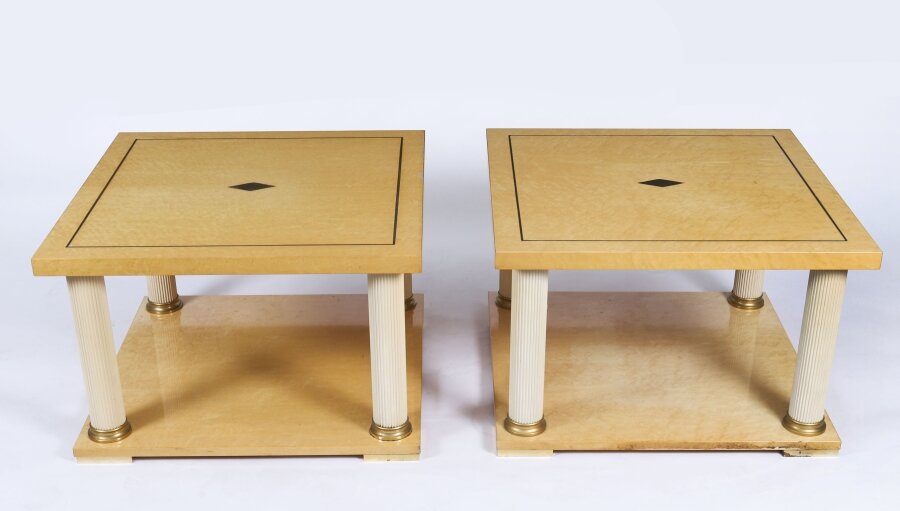
Birdseye Maple
occurs primarily in Sugar Maple and is a very hard wood with divergent grain structure caused by the presence of the Birdseyes.
In the days when all furniture was made essentially by hand, Birdseye Maple was used by only the most capable cabinetmakers. These artisans had developed the tools and skills to work and finish Birdseye Maple successfully. Antique furniture made out of Birdseye Maple is rare and beautiful.
The divergent grain that makes Birdseye Maple beautiful also makes it difficult to work. Early woodworking machines ran at low rpms and had only 2 knives per cutterhead. This often produced Birdseye surfaces that were chipped and torn. It took many hours of hand planing and scraping to get these surfaces to a high sheen.
This limited the use of Birdseye maple to projects whose value could justify the extra labour cost. Examples of this are fine furniture and musical instruments.
The UK's second-biggest shop, Selfridges, Oxford Street, is a little over half the size with 540,000 square feet (50,000 m2) of selling space, while the third largest, Allders of Croydon had 500,000 square feet (46,000 m2) of retail space.
By comparison Europe's second-largest department store the KaDeWe in Berlin has a retail space of 650,000 square feet (60,000 m2).