Corby Castle
One of Cumbria’s most historically important mansion houses, grade I-listed Corby Castle sits on a plateau, rising above the picturesque River Eden to the east of Carlisle. The Manor of Corby was granted to Hubert de Vallibus by Henry II and passed to Andrew de Harcia, Earl of Carlisle before being given to Richard Salkeld in 1336. The estate remained in the hands of the Salkeld family until it was sold in 1611 to Lord William Howard, the third son of Thomas Howard, 4th Duke of Norfolk. The house is built around a red sandstone peel tower, or fortified tower house, built in the 13th century; William Howard added a two-storied L-shaped house to the peel tower, and the house was once again modified in the early 19th century by descendant Henry Howard. Between 1812 and 1814, Scottish architect Peter Nicholson gave the castle a new rectangular plan and the harmonious neo-classical façade in the distinctive local red sandstone that graces the building today. Corby Castle remained in the Howard family until 1994, when Lord and Lady Ballyedmond, as new owners, began an inspired revival of Corby, giving new life to one of the great Cumbrian mansions.
Ormolu
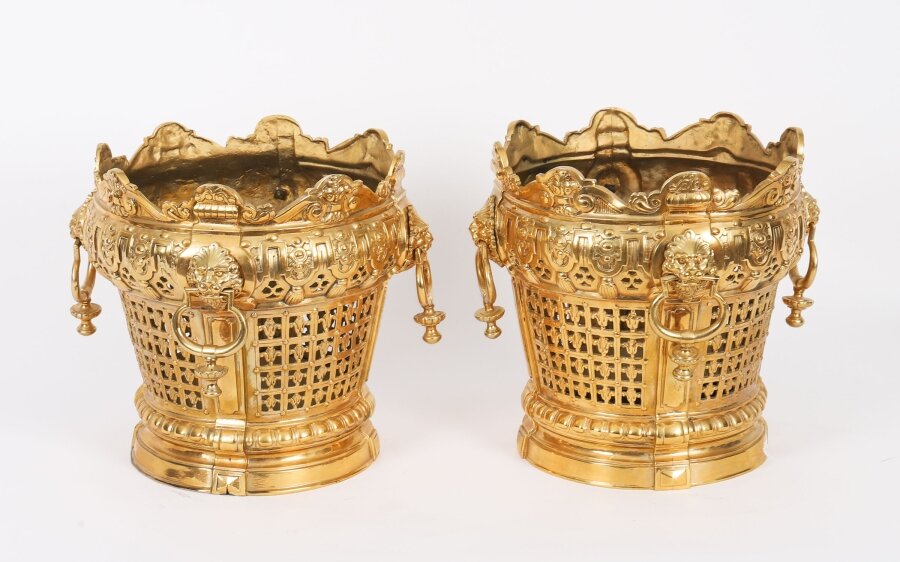
(from French 'or moulu', signifying ground or pounded gold) is an 18th-century English term for applying finely ground, high-carat gold in a mercury amalgam to an object of bronze.The mercury is driven off in a kiln leaving behind a gold-coloured veneer known as 'gilt bronze'.
The manufacture of true ormolu employs a process known as mercury-gilding or fire-gilding, in which a solution of nitrate of mercury is applied to a piece of copper, brass, or bronze, followed by the application of an amalgam of gold and mercury. The item was then exposed to extreme heat until the mercury burned off and the gold remained, adhered to the metal object.
No true ormolu was produced in France after around 1830 because legislation had outlawed the use of mercury. Therefore, other techniques were used instead but nothing surpasses the original mercury-firing ormolu method for sheer beauty and richness of colour. Electroplating is the most common modern technique. Ormolu techniques are essentially the same as those used on silver, to produce silver-gilt (also known as vermeil).