Southwick Hall, Northamptonshire
Dating from the late Middle Ages, Southwick Hall rises in a secluded valley near Oundle in Northamptonshire — a district “where fine churches and historic houses are to be found at every turn” With its origins around 1300, the house remains a rare survivor among England’s great country houses. The Elizabethan reconstruction in the 1570s was undertaken by Thomas Thorpe, the mason who also worked on nearby Kirby Hall and Apethorpe Palace, a favourite royal residence of James I.
Over the centuries, Southwick Hall has passed through just three families: the Knyvetts (1300–1441), Lynnes (1441–1841), and Caprons (1841–present day) — each contributing a fascinating cast of characters. From soldiers and politicians to lawyers and artists, they include a Lord Chancellor under Edward III; a protégé of Lord Cecil Burghley associated with the execution of Mary Queen of Scots at nearby Fotheringhay; Oliver Cromwell’s mother, Elizabeth; the Enlightenment scientist George Lynne VI; and his son George VII, who died in a duel at Apethorpe, bringing an end to the Lynne family’s tenure.
While the Lynnes were keen Grand Tour collectors, the items included in this sale date from the Capron family’s stewardship, acquired from the 1840s onwards. The Caprons were also distinguished travellers and scholars — serving in West Africa and India, journeying through the Alps and Italian Lakes, and collecting widely. Roderick Capron (1908–43), a geographer, antiquary, and art collector, volunteered as a navigator on a Lancaster bomber and was killed in action over Holland. His mother, from the Walker family of Leicester, was a talented musician and diarist. The current incumbent, Christopher Capron, was Head of Current Affairs at the BBC, producing Question Time and Panorama.
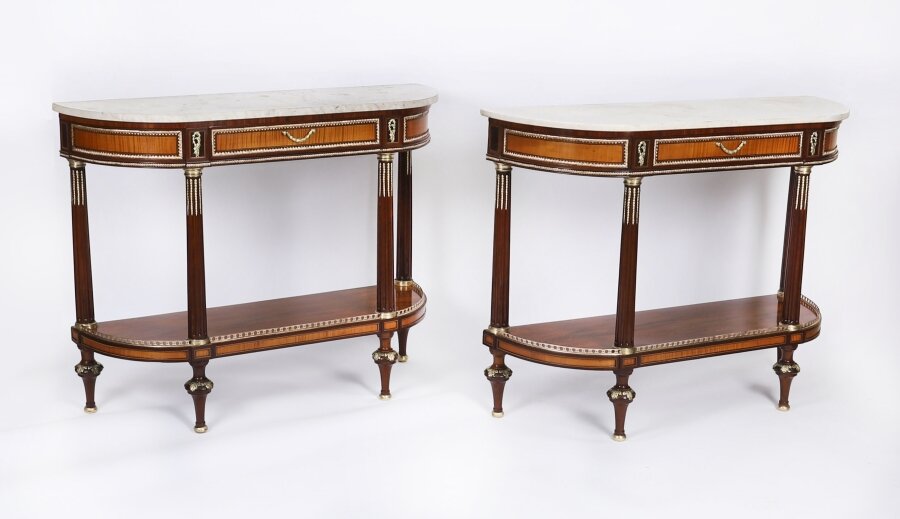
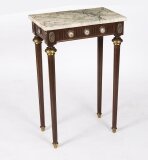
Carrara marble - is a type of white or blue-grey marble popular for use in sculpture and building decor. It is quarried at the city of Carrara in the province of Massa-Carrara (Tuscany, Italy).
Carrara marble has been used since the time of Ancient Rome; the Pantheon and Trajan's Column in Rome are constructed of it. Many sculptures of the Renaissance, such as Michelangelo's David, were carved from Carrara marble. For Michelangelo at least, Carrara marble was valued above all other stone, except perhaps that of his own quarry in Pietrasanta. The Marble Arch in London and the Duomo di Siena are also made from this stone, as are the interiors of Manila Cathedral, the cold-white marbles of the Sheikh Zayed Mosque and the campus of Harvard Medical School.
Satin wood
is a hard and durable wood with a satinlike sheen, much used in cabinetmaking, especially in marquetry. It comes from two tropical trees of the family Rutaceae (rue family). East Indian or Ceylon satin wood is the yellowish or dark-brown heartwood of Chloroxylon swietenia.
The lustrous, fine-grained, usually figured wood is used for furniture, cabinetwork, veneers, and backs of brushes. West Indian satin wood, sometimes called yellow wood, is considered superior. It is the golden yellow, lustrous, even-grained wood found in the Florida Keys and the West Indies.
It has long been valued for furniture. It is also used for musical instruments, veneers, and other purposes. Satinwood is classified in the division Magnoliophyta, class Magnoliopsida, order Sapindales, family Rutaceae.