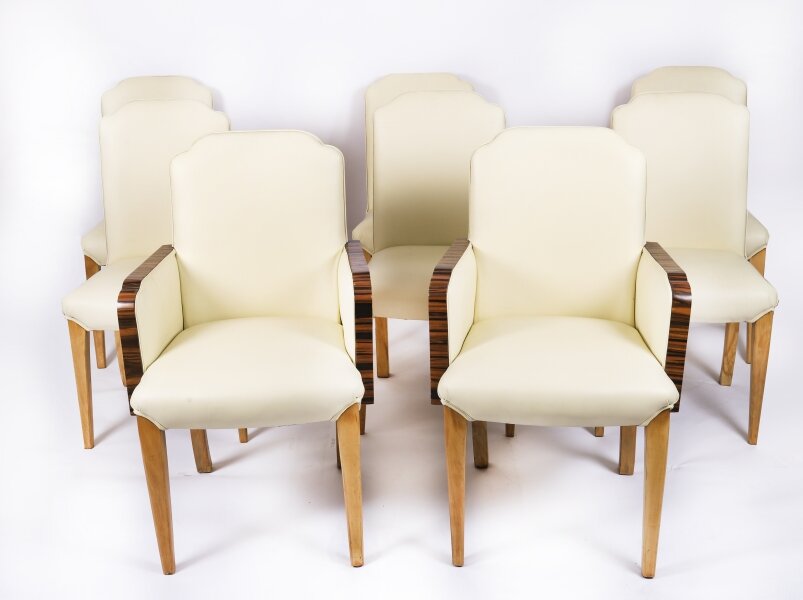
Epstein furniture
was originally founded in East London by Polish immigrants in the 1890s. The firm passed to brothers Harry and Lou Epstein and the pair turned their attention to the production of Art Deco forms from the 1930s until the 1950s.
Finished to high standards, most pieces were custom-made in veneers of burr maple, sycamore or walnut. The design of the famous ‘cloud’ seat furniture is credited to Epstein and the company also popularized the uniquely British taste in suite furniture.
Following World War II, Epstein had showrooms in London, Manchester and Glasgow. A conservative Art Deco style became the company`s trademark after the war and most pieces were made from bleached walnut. Art Deco pieces are not signed.
From the 1960s, some pieces were labelled ‘H. & L. Epstein’ or ‘Epstein & Goldman’.
Art Deco or Deco,
is an influential visual arts design style which first appeared in France during the 1920s, flourished internationally during the 30s and 40s.
It is an eclectic style that combines traditional craft motifs with Machine Ageimagery and materials. The style is often characterized by rich colours, bold geometric shapes, and lavish ornamentation.
Deco emerged from the Interwar period when rapid industrialization was transforming culture. One of its major attributes is an embrace of technology. This distinguishes Deco from the organic motifs favored by its predecessor Art Nouveau.
Historian Bevis Hillier defined Art Deco as "an assertively modern style...[that] ran to symmetry rather than asymmetry, and to the rectilinear rather than the curvilinear; it responded to the demands of the machine and of new material...[and] the requirements of mass production".
During its heyday Art Deco represented luxury, glamour, exuberance, and faith in social and technological progress.
Coromandel wood or Calamander wood
is a valuable wood from India, Sri Lanka and South East Asia. It is of a hazel-brown color, with black stripes (or the other way about), very heavy and hard. It is also known as Macassar Ebony or variegated ebony and is closely related to genuine ebony, but is obtained from different species in the same genus; one of these is Diospyros quaesita Thwaites, from Sri Lanka. The name Calamander comes from the local sinhalese name, 'kalu-medhiriya', which means dark chamber; referring to the characteristic ebony black wood.
Coromandel wood has been logged to extinction over the last 2 to 3 hundred years and is no longer available for new work in any quantity. Furniture in coromandel is so expensive and so well looked after that even recycling it is an unlikely source. A substitute, Macassar Ebony, has similar characteristics and to the untrained eye is nearly the same but it lacks the depth of colour seen in genuine Coromandel.
Walnut & Burr Walnut
Walnut is a hard, dense, tight- grained wood that polishes to a very smooth finish. It is a popular and attractive wood whose colour ranges from near white in the sapwood to a dark hew in the heartwood. When dried in a kiln, walnut wood tends to develop a dull brown colour, but when air-dried can become a rich purplish-brown. Because of its colour, hardness and grain, it is a prized furniture and carving wood. Walnut veneer was highly priced and the cost would reflect the ‘fanciness’ of the veneer – the more decorative, then the more expensive and desirable.
Burr walnut refers to the swirling figure present in nearly all walnut when cut and polished, and especially in the wood taken from the base of the tree where it joins the roots. However the true burr is a rare growth on the tree where hundreds of tiny branches have started to grow. Burr walnut produces some of the most complex and beautiful figuring you can find.