
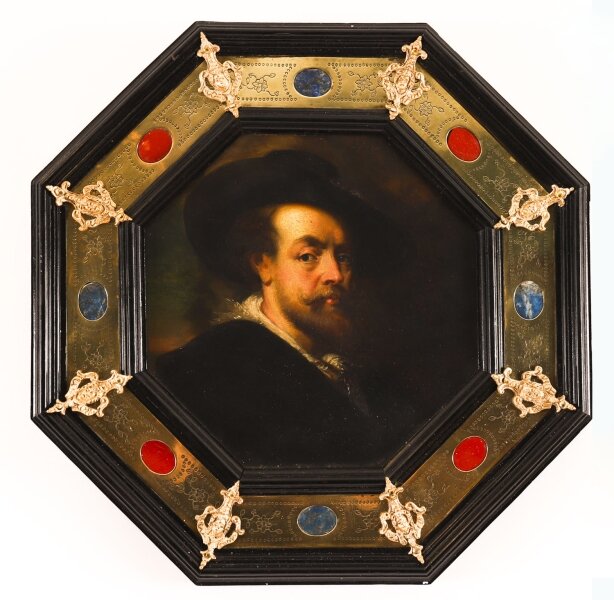



An antique Florentine copy of a self-portrait by Peter Paul Rubens (1577-1640) painted by F. Flor for Flor & Findel, early 19th century.
The portrait is framed in the original carved Florentine octagonal ebonised frame with an ornate thick ormolu band inset with Agate and Lapis Lazuli stones.
Inscribed verso: 'Portrait of Rubens by himself, copied by F. Flor, sold by Messrs Flor & Findel, picture dealers, Florence'.
Flor & Findel were booksellers and stationers in Florence and as was common in the nineteenth century they were also picture dealers.
Add some classical elegance to your home with this charming painting.
The portrait is framed in the original carved Florentine octagonal ebonised frame with an ornate thick ormolu band inset with Agate and Lapis Lazuli stones.
Inscribed verso: 'Portrait of Rubens by himself, copied by F. Flor, sold by Messrs Flor & Findel, picture dealers, Florence'.
Flor & Findel were booksellers and stationers in Florence and as was common in the nineteenth century they were also picture dealers.
Add some classical elegance to your home with this charming painting.
Condition:
In excellent condition the painting and frame having been delicately cleaned in our workshops, please see photos for confirmation.
Dimensions in cm:
Height 37 cm x Width 37 cm x Depth 4 cm - Frame
Height 22.5 cm x Width 22.5 cm - Painting
Dimensions in inches:
Height 1 foot, 3 inches x Width 1 foot, 3 inches x Depth 2 inches - Frame
Height 9 inches x Width 9 inches - Painting
Our reference: A4624
Please feel free to email or call us (+44 20 8809 9605) to arrange a viewing in our North London warehouse.