The Grand Tour was the traditional trip of Europe undertaken by mainly upper-class European young men of means. The custom flourished from about 1660 until the advent of large-scale rail transit in the 1840s, and was associated with a standard itinerary.
It served as an educational rite of passage. Though primarily associated with the British nobility and wealthy landed gentry, similar trips were made by wealthy young men of Protestant Northern European nations on the Continent, and from the second half of the 18th century some South American, U.S., and other overseas youth joined in. The tradition was extended to include more of the middle class after rail and steamship travel made the journey less of a burden.
The primary value of the Grand Tour, it was believed, lay in the exposure both to the cultural legacy of classical antiquity and the Renaissance, and to the aristocratic and fashionably polite society of the European continent. In addition, it provided the only opportunity to view specific works of art, and possibly the only chance to hear certain music. A grand tour could last from several months to several years. It was commonly undertaken in the company of a knowledgeable guide or tutor.
The Grand Tour not only provided a liberal education but allowed those who could afford it the opportunity to buy things otherwise unavailable at home, and it thus increased participants' prestige and standing. Grand Tourists would return with crates of art, books, pictures, sculpture, and items of culture, which would be displayed in libraries, cabinets, gardens, and drawing rooms, as well as the galleries built purposely for their display; The Grand Tour became a symbol of wealth and freedom.
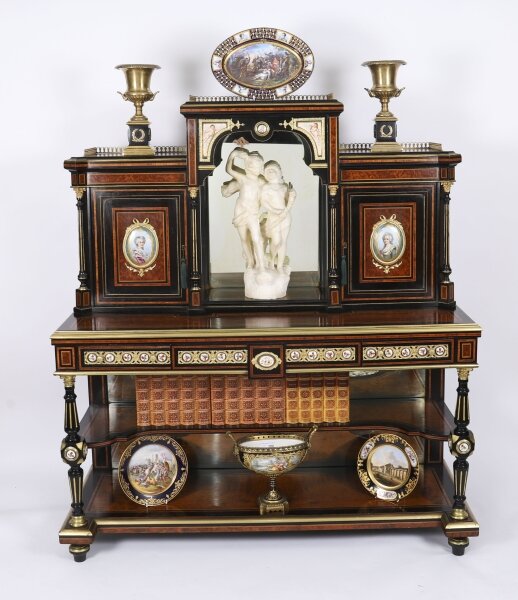
A bonheur du jour (in French, bonheur-du-jour, meaning "daytime delight") is a type of lady's writing desk. It was introduced in Paris by one of the interior decorators and purveyors of fashionable novelties called marchands-merciers about 1760, and speedily became intensely fashionable.
The bonheur du jour is always very light and graceful, with a decorated back, since it often did not stand against the wall but was moved about the room. Its special characteristic is a raised back, which may form a little cabinet or a nest of drawers, or open shelves, which might be closed with a tambour or may simply be fitted with a mirror. The top, often surrounded with a chased and gilded bronze gallery, serves for placing small ornaments. Beneath the writing surface there is usually a single drawer, often neatly fitted for toiletries or writing supplies.
Early examples were raised on slender cabriole legs; under the influence of neoclassicism, examples made after about 1775 had straight, tapering legs. The marchand-mercier Simon-Philippe Poirierhad had the idea of mounting bonheurs du jour with specially-made plaques of Sèvres porcelainthat that he commissioned and for which he had a monopoly; the earliest Sèvres-mounted bonheur du jours are datable from the marks under their plaques to 1766-67. The choicer examples of the time are inlaid with marquetry or panels of Oriental lacquer, banded with exotic woods, with gilt-bronze mounts.
By the mid-1770s the bonheur du jour was being made in London, where it was simply called a "lady's writing-desk".
Sevres Porcelain traces its roots in France to early craftsmen who had small manufacturing operations in such places as Lille, Rouen. St. Cloud, and most notably Chantilly. It is from Chantilly that a cadre of workers migrated to the Chateau de Vincennes near Paris to form a larger porcelain manufactory in 1738. French King Louis XV, perhaps inspired by his rumoured relationship with mistress Madame de Pompadour, took an intense interest in porcelain and moved the operation in 1756 to even larger quarters in the Paris suburb of Sevres. Sevres was also conveniently near the home of Madame de Pompadour and the King's own Palace at Versailles.
From the outset the king's clear aim was to produce Sevres Porcelain that surpassed the established Saxony works of Meissen and Dresden. Though the French lacked an ample supply of kaolin, a required ingredient for hard-paste porcelain (pate dure), their soft-paste porcelain (pate tendre) was fired at a lower temperature and was thus compatible with a wider variety of colours and glazes that in many cases were also richer and more vivid. Unglazed white Sevres Porcelain "biscuit" figurines were also a great success. However, soft-paste Sevres Porcelain was more easily broken. Therefore, early pieces of Sevres Porcelain that remain intact have become rare indeed.
The Sevres Porcelain manufactory always seemed to be in dire financial straits despite the incredibly fine works it produced. In fact, the king's insistence that only the finest items be created may have contributed to the difficulties. Only a limited number of European nobility could afford the extravagant prices demanded for such works. King Louis XV and eventually his heir, the ill-fated Louis XVI, were obliged to invest heavily in the enterprise. Ultimately, the Sevres Porcelain Factory produced items under the name of "Royal" and thus the well-known Sevres mark was born. King Louis XV even mandated laws that severely restricted other porcelain production in France so as to retain a near monopoly for his Sevres Porcelain. The king even willingly became chief salesman for the finest of his products, hosting an annual New Year's Day showing for French nobility in his private quarters at Versailles. He eagerly circulated among potential buyers, pitching the merits of ownership and policing the occasional light-fingered guest.
Sevres Porcelain may have indeed given the makers of Meissen and Dresden a run for their money by the end of the 18th Century but for the French Revolution. By 1800, the Sevres Porcelain Works were practically out of business due to the economic devastation of the new French Republic.
About the time when Napoleon Bonaparte named himself Emperor of France (1804), a new director was named for the Sevres Porcelain Manufactory. Alexandre Brongniart, highly educated in many fields, resurrected Sevres Porcelain. Soft-paste porcelain was eliminated altogether thanks to the earlier discovery of kaolin near Limoges. For four decades until his death, Brongniart presided over monumental progress for Sevres Porcelain, catering not only to Napoleon himself, but at last to include the more financially profitable mid-priced market in the emerging middle class.
Amboyna
is a type of wood which has its origins in Indonesia (the preferred veneer comes particularly from the Andaman Islands). The grain texture is one of the most seldom and exclusive on earth.
The burls are often very small, which is why the sheets of veneer come in small dimensions. The colours range from deep yellowish-orange to dark red.
After finishing the surface, the grain texture of amboyna wood has a depth and richness unmatched in other textured woods.
Thuya Wood.
Thuya wood is one of the most exclusive timbers, is incredibly rare, and is only found on exceedingly luxurious pieces of furniture
Thuya wood usually ranges in colour from a golden brown to a medium reddish brown. It has a characteristic three dimensional light and shade patterned appearance, accompanied by a multitude of small dark ‘eye’ formations.
Sourced from an evergreen conifer, Thuya wood is primarily native to the Atlas mountains of Morocco, Algeria and Tunisia in north-west Africa, with smaller settlements in Malta and near Cartagena in south-east Spain.
The most desirable parts of the wood are obtained from the burrs that are located underground within the large roots of the tree. Whilst rarely used by English cabinet makers and box makers, Thuya wood tended to be more favoured by their French counterparts