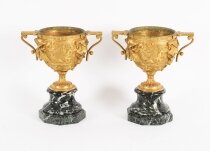

A stunning and lifelike sculpture of a rider on the hunt with his bugle.
The piece is set on an attractive marble base.
Bearing the replica signature of Pierre Jules Mene.
This high quality bronze is a hot cast recast of an original produced using the 'lost wax' (cire perdue) process.
Height 38 cm
Width 34 cm
Depth 13 cm
Approx. weight 8.7 kg
Sometimes called by the French name of 'cire perdue' or the Latin, 'cera perduta' is the process by which a bronze or brass is cast from an artist's sculpture.
In industrial uses, the modern process is called investment casting. An ancient practice, the process today varies from foundry to foundry, but the steps which are usually used in casting small bronze sculptures in a modern bronze foundry are generally quite standardised.
Pierre Jules Mêne (1810 -1879), was a French Sculptor and animalière. He is considered to be the pioneer of animal sculpture in the nineteenth-century.
Mêne produced a number of animal sculptures, mainly of domestic animals like horses, cows and bulls, sheep, goats, etc., which were in vogue during the Second Empire. He was one of a "school of French animalières" which also included Pierre Louis Rouillard, Antoine-Louis Barye, Auguste Caïn, and François Pompon. Mêne himself specialized in small bronze figures which explains why none of his works exist as public statuary.
His work was a popular success with the bourgeois class and many editions of each sculpture were made, often to decorate the increasingly private homes of the period. The quality of these works is high, comparable to Barye's. Mêne also seems to have enjoyed a longer period of success and celebrity than his contemporaries. He is considered to have been the Lost-wax casting expert of his time, later surpassed only by Auguste Rodin.